



Is Anything Ever Truly “Lost In Translation”?

Written By: Manuela Medeiros
Whilst the world nods in agreement that the way to one’s heart is through their stomach, I argue that its path lies through language—through expression. It is not about fluency. It is about how language makes us feel, as if its sound carries a translation we didn’t even know we needed to hear, though it has existed since our first breath. There’s a theory that language shapes the way we think—that words don’t just describe our world; they create it. Over 7,000 languages currently exist, and over 600 are extinct. Yet, all share one common thread: they grant mankind the ability to communicate, to express, and to unravel life’s greatest mysteries: love and language. Ranging from a subtle “hello” to fist bop, language isn't limited to words—it is a glass slipper, one-size fits all. Let it be idiom, gestures or a facial expression; humans have been searching for ways to communicate without using dialect ever since social media exploded; thousands of emoticons and gifs—no translation, just a universal language that ties all of us together.
What your eyes can’t see, your ears can't hear, but your heart can feel–language proves itself to be more than a soulless system. One can't 'hear happiness’ or listen to ‘sorrow’, we simply feel it. Whether it is a slight curl of pink lips or deep brown eyes squinting with glimmer; emotion can never truly be lost in translation. Take, for instance, a multinational couple. Two different languages, two different people, a thousand words and a million feelings—yet they communicate not just with words, but through shared moments and unspoken feelings. The depth of their connection cannot be fully translated into language; it transcends words, just as all human connection does. A soul isn't verbal, a soul is defined by the Oxford dictionary as a “strong and good human feeling, especially that gives a work of art its quality or enables somebody to recognize and enjoy that quality.”. Just as a piece of art can evoke emotion without a single word being spoken, the soul communicates with us in ways that go beyond language.
Furthermore, this essay argues that despite language solidifying communication, its essence transcends dialect; the cliché “lost in translation” is nothing more than a hyperbole— an excuse often created by mankind to avoid confronting life's wonders beyond its borders, missing the deeper emotions that bind us all. What makes us human, what makes someone American or Brazilian isn't the fact that they speak those languages, it is the fact that their soul, at its core, expresses itself with gusto and pride.
If humans existed long before the advent of language, why should it now define us as individuals?
Along with the emergence of homo sapiens, the first language was born: Sumerian, a language originated in southern mesopotamia during the 3rd millennium bce. Despite its recognition for being one of the first ever recorded languages, Sumerians were not the only urban civilizations to develop their own dialect. Egyptian, Proto-Sinaitic, Harappan and Chinese (Oracle Bone Script) were all languages that existed within a near time frame as Sumerian, dating back to 2500+ bce. Ostensibly, at that point, it is safe to argue that there wasn't anything as such “lost in translation”; language barriers were not thought of the same as they are in modern society. Going back to a bce time frame, primal communication was merely rudimentary, made for survival and not for communication.
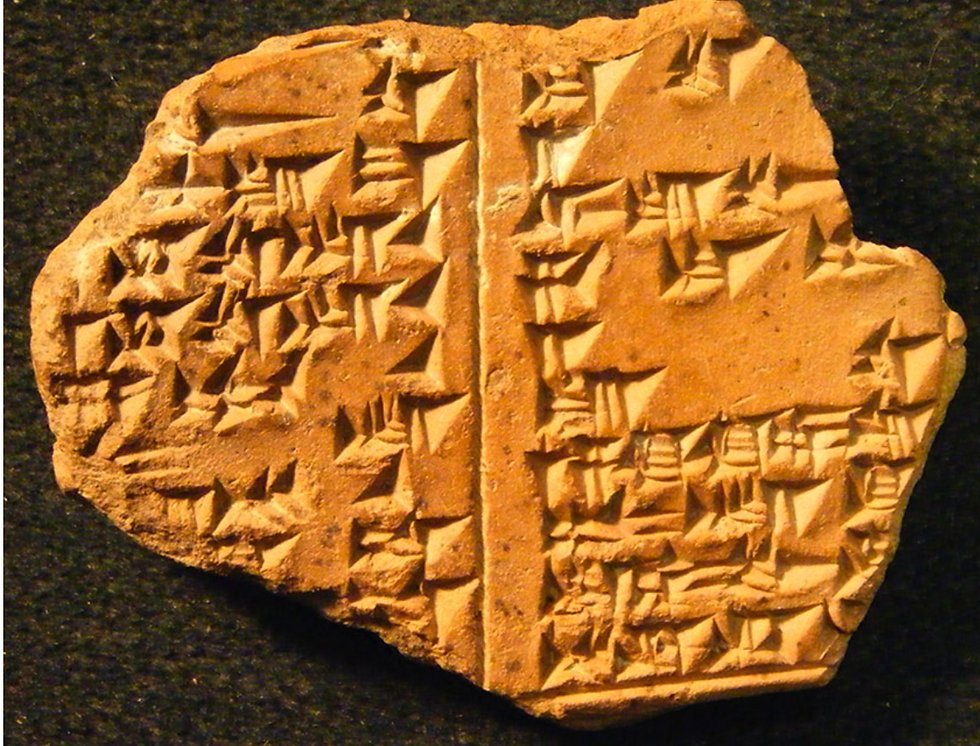
Fig 1. Sumerian carved into a rock with their Akkadian synonyms dating from c. 3300-3100 bce.
After written language allowed for even more complex ideas to be communicated. But, as one might imagine, with different languages and writing systems emerging around the world, misunderstandings would have arisen if people didn’t share the same system of communication. In ancient times, when citizens from different regions came into contact, whether through trade, war, or migration, there were language barriers. This would have led to issues such as misinterpretations, or even full-on breakdowns in communication, essentially, a very real version of “lost in translation.”
Before the development of full-fledged languages, early humans communicated using simple gestures and vocalizations; enough to express basic needs like “danger”, "food” or “help". This could be referred to as a “proto-language”, This was more than just survival grunts, it was the beginning of something deeper, the first whispers of what we now call language; where grunts and screeches most likely prevailed over actual speech or language and verbal communication was inherently featureless and unstructured.
As human societies grew larger and more complex, the sophistication of languages began to overrule animalistic gestures and sounds. Alongside the rise of phonemes, humans started combining words and developing a sense of grammar within the structure of their sentences. Not yet as complex as modern day dialects, these languages would now allow for communication outside of survival, allowing mankind to tell stories, give instructions or make plans.
Interestingly, even in ancient times, people often spoke multiple languages. Ancient Egyptians, for example, had diplomatic languages, such as Akkadian, which was used for interacting with people from other regions. Merchants, traders, and diplomats would have been bilingual or multilingual which facilitated communication across borders . Sometimes, interpreters would have been necessary for translating between different languages or dialects; examples seen in the ancient world when kings or rulers who spoke different languages sent messages or wrote decrees that needed to be translated.
Regardless of middle men who would translate each and every word for you, it is vital to recognize that humans are widespread across the globe, prevailing in different regions and scattered across cities and countries; each adapting to their own proper dialect or entirely different languages. At that point, if two citizens from different regions tried to communicate, it is tangible that they might not understand each other fully, though they might rely on gestures, expressions or even body language to bridge the gap. In some ways, humanity has “universal” communication facilitated by gestures or simple signs; debunking the theory that human dialect was ever truly lost in translation.
While our ancestors carved words into clay, the tools of communication evolved, slowly but surely, with each generation. In the 21st century, we have new virtual tools — like Google Translate and emojis— that continue to break down barriers and refine the way we connect with one another. Whilst it may be odd to remark to the existence of electronics when speaking about language and communication, the argument that electronics and its add-ons, ergo google translate, allow humans to demolish any linguistic barriers by facilitating international communication through the use of AI—a tool enabling the translation of over 4,000+ languages from text to speech. When dating back to a contemporary society, access to our modern gadgets was scarce, making the access to AI or Internet Browsers, which were nowhere near their creation, impossible. Consequently, when facing the question of getting ‘lost in translation’, establishing a time frame is of essence; whether it dates back to 3000+ years bce or 2023, getting lost in translation was far more often in a historical context due to the lack of tools we have today; tools that enable us to communicate with societal groups kilometers away from us—from China to the USA, we may not be lost in translation now but we once sure were.
Wittgenstein claims that “The limits of my language mean the limits of my world.” and proves that the only true limit of his world is ignorance. Wittgenstein’s belief is founded upon the idea that humans can and will communicate solely via language, which may be the case in Mars but not on Earth. This perspective, taken from the Tractatus Logico-Philosophicus, implies that human understanding is constrained by the language we possess. If a word doesn’t exist for a concept, can the concept ever be fully grasped? Neuroscience has shown multiple times how humans are wired to read micro-expressions and emotional cues subconsciously, conducting experiments with the limbic system in the brain that helps mankind interpret emotional signals without verbal input. Our brains are trained to read between the lines of language—detecting sorrow in a lowered gaze, or joy in a twinkle. Science tells us the heart sometimes understands before the ear ever hears. According to research in cognitive linguistics, the brain often interprets meaning in gesture, tone and facial expression even before processing spoken words. In one study by Mehrabian and Ferris, only 7% of emotional meaning face-to-face communication came from the words themselves: 38% through tone and 55% through body language. A few words, a quiet sound, and a mere stare. And that too, is language—just not one you can quote.
Adjacent to science, Wittgenstein evolved—and so did his beliefs: from rigid structures to flexible usages—further proof that the essence of meaning lies not in syntax, but in human context. This shift supports the theory that even if a word does not directly translate, meaning can still be preserved through human interaction, shared context, and cultural understanding.
And if so, if ancient homo sapiens could survive through the use of simple gestures and body language, why can't we?
When watching any classic cinematic masterpiece like “La La Land” or “Interstellar”, the first thing that catches the audience’s curious eye is not their dialogue; it’s their look, it’s their story. “Show not tell”—a renowned saying used by cinema enthusiasts to explain how real film is created. When Emma Stone’s glance becomes a universal language: joy, sadness, worry and fear—a look recognized worldwide regardless of the language or the subtitles, that stare is understood by the entire globe.

Fig 2. Goslin’s Sebastian and Emma’s Mia final look in “La La Land”. A goodbye without bitterness and an emotionally raw eye contact between characters and a symbol of the reality of relationships.
Whether it is Samba in New York or Frevo in New Delhi, language has a voice beyond movie screens—it speaks through dance. Without needing lyrics or translations, musical genres such as K-Pop have topped the charts globally every year, with 38% clearance in 2020; an achievement not even a dictionary could capture. Considering that the estimated time to reach fluency in Korean is around 2,200 class hours and its complex grammar and syntax places it in category IV of the linguistic spectrum: “very hard”, K-Pop stans all around the world remain enthusiastic enough to listen to it on repeat; “lost in translation” isn’t anything compared to their love for music.
From the The National Gallery in London to the Anahuacalli in Mexico, art is bound by nothing—and so is language. A Van Gogh painting does not beg to be understood in Dutch. Its strokes scream in color, speak in silence, and whisper techniques and emotions that no language can’t. One glimpse and a million emotions, Gogh’s loneliness and despair has a voice of its own—it doesn’t need complex grammar or a strong accent. Whilst some rely on words to express their feelings, Frida Khalo used herself. Fifty-five self portraits—“I paint myself because I am so often alone and because I am the subject I know best.” Khalo’s gaze was turned inward, her art imbued with a feminine voice of pain and perseverance. Her paintings wouldn’t speak in Spanish, they’d speak in elegance. Her audience didn’t have to understand her language, they only had to understand her.

Fig 3. Frida Khalo’s 1944 “The Broken Column” piece. Made after she underwent spinal surgery and symbolizes her physical and emotional pain.
Language is not static. It evolves, morphs and shapes. The word “robot” comes from the Czech robota, meaning forced labor. “Emoji” comes from Japanese ‘絵文字’, meaning “picture character”. Both now carry meanings beyond their etymological origins—a process of translation where its meaning isn’t lost, only expanded—enriched.
Charlie Chaplin never needed a script to make us laugh—or cry. His eyebrows did the talking, his limp the narrative. In his silence, we heard everything.
It is impossible to deny that the cliché “lost in translation” evokes a sense of helplessness—a moment where meaning slips through the cracks between languages, paving the way for confusion and misinterpretation. When a mistranslated political speech causes diplomatic tension or a poorly localized film script may lose cultural significance; these examples aren’t just fiction, they’re real. Nikita Khrushchev’s 1956 “We will bury you” was a polysemy, in english it was a direct nuclear threat, in russian it was a message of hope and survival. Khrushchev was, quite literally, lost in translation. As if Khruschev’s double entendre wasn’t enough of a blow for our argument, the ironical misunderstanding of the 2003 film “Lost in Translation” brings us the concept of a satirized nuance and tone being butchered in translation; playing on the exact theory that sometimes translation prioritizes speed over depth.
On the other hand, the Japanese’s juxtaposing interpretation of “perfection” is the concept of “wabi-sabi”—a worldview centered around the beauty of imperfection and impermanence. Despite its universal use, English has no word that captures the melancholic essence of this japanese beauty. In Portuguese, “saudade” explains more than just its name; it feels the longing of one’s absent love. Nonetheless, while we can try to explain the meaning of these ideas, something will always get left behind. The emotion might be felt, but the cultural texture can always fade.
Now even in the absence of formal language, infants can point, cry, smile and mimic—demonstrating the universality and adaptability of human communication beyond language and establishing the clear distinction between linguistic competence and cognitive ability. Similar to Steven Pinker’s argument that language is an innate ability, but communication precedes language.
And yet, even when words fail, humanity still tries to understand each other. We may not understand what “saudades” is, but we know what longing feels like. Our translation may be faulty, but our intentions remain untouched. This is where the reality of “lost in translation” becomes blurry.
Differing itself from many cases, translation will sometimes force us to dig deeper, to reinterpret rather than repeat. Translators are not just linguistic masterminds; they are artists. Think of Seamus Heaney translating Beowulf or Gregory Rabassa’s rendering of Gabriel Márquez. They didn’t just translate words, they translated worlds.
Lost in translation isn’t a myth or a reality; it’s both. When we expect a one-to-one equivalence between languages, it is real. When we accept that language isn’t about perfection or precision, it is a myth. If the purpose of language is ever but not to duplicate but to connect, nothing can ever truly be lost.
As society opens itself to the fact that language isn’t a locket gate—it’s the key that opens it, we face its emotional and social implications. In 2023, 4.3 million non EU immigrants arriving at EU nation; immigration isn’t just a mere action, it’s change. Let it be a child of Turkish parents in Germany, they most likely speak Turkish at home but at school, German prevails—language becoming a bridge between generations, not a barrier.
You might not be able to say “I love you” in your partner’s native tongue but love can be shown in a borrowed phrase. From “Thank you” to “Obrigada”, love can never be translated.
As technology unfolds before our eyes, language becomes its global connector. Despite imperfect translations and internet dependent conversations—the technological intention to connect shows that a connection across borders can be established immediately. Let it be Duolingo with its 34+ million monolingual or soon to be bilingual, trilingual or quadrilingual users or Google Translate with 100+ languages being translated; there are no longer excuses not to learn, or at least try to.
Whilst technology advocates for a more scientifically defined approach on human communication, diplomacy calls for a geopolitical perspective. Having lived through multiple crises, political organs are proof that wars begin when communication fails. Ranging from United Nations interpreters who ensure that leaders can speak across language barriers to multilingual negotiations within peace treaties—in diplomacy, language is the tightrope between war and peace.
After all, is anything ever truly lost in translation, or do we simply fail to listen with the heart?
Language is not a wall, it is a window. It is not a closed door, but a key to understanding. Aging from pre historical cave drawings to K-pop lyrics, from Chaplin’s silent films to Khalo’s loud grief, language will never belong to words alone. It lives in glances, gestures, colors and rhythm.
To give into saying “lost in translation” is to underestimate the resilience of human connection. What matters—the ache in a voice, the tenderness of a brushstroke, the joy in shared laughter—can never be confined by grammar or syntax. Language is not just spoken, it is felt. And when something is felt, it can never be lost.
In a world that often points out what separates us, the time has come for us to focus on what binds us. Not fluency or vocabulary but the universal desire to be understood—and the infinite ways we already are.
Works Cited:
Ethnologue. “How Many Languages Are There in the World?” Ethnologue, 2024, www.ethnologue.com/insights/how-many-languages/.
Sichel, Barb. “Extinct Languages: When and Why They Die off | ILS.” ILS Translations, 12 Nov. 2019, www.ilstranslations.com/blog/understanding-extinct-languages-when-and-why-they-die-off/.
“Soul Noun - Definition, Pictures, Pronunciation and Usage Notes | Oxford Advanced Learner’s Dictionary at OxfordLearnersDictionaries.com.” Www.oxfordlearnersdictionaries.com, www.oxfordlearnersdictionaries.com/definition/english/soul.
Gelb, Ignace. “Sumerian Language | History, Characteristics, & Facts.” Encyclopædia Britannica, 2019, www.britannica.com/topic/Sumerian-language.
“Which Is the Oldest Language in the World? | Dynamic Language.” Dynamiclanguage.com, 2018, www.dynamiclanguage.com/which-is-the-oldest-language-in-the-world/.
“Nimrud: Materialities of Assyrian Knowledge Production - the Sumerian Language.” Upenn.edu, 2019, oracc.museum.upenn.edu/nimrud/ancientkalhu/thewritings/sumerian/index.html, http://oracc.museum.upenn.edu/nimrud/ancientkalhu/thewritings/sumerian/.
Phillips, Matt. “How Speech Began.” National Endowment for the Humanities, 28 Apr. 2021, www.neh.gov/article/how-speech-began.
“The Big Bookshelf of Phonology (Part II): Phonemes.” Mark Weakland Literacy, 2021, www.markweaklandliteracy.com/blog/the-big-bookshelf-of-phonology-part-ii-phonemes. Accessed 2 July 2025.
Fan, Angela. “Introducing the First AI Model That Translates 100 Languages without Relying on English.” About Facebook, 19 Oct. 2020, about.fb.com/news/2020/10/first-multilingual-machine-translation-model/.
“Ludwig Wittgenstein Quotes (Author of Tractatus Logico-Philosophicus).” Www.goodreads.com, www.goodreads.com/author/quotes/7672.Ludwig_Wittgenstein.
team, NeuroLaunch editorial. “Micro Expressions in Psychology: Decoding Hidden Emotions.” NeuroLaunch.com, 14 Sept. 2024, neurolaunch.com/micro-expressions-psychology/.
“Mehrabian’s Communication Study.” Changingminds.org, changingminds.org/explanations/behaviors/body_language/mehrabian.htm.
“La La Land : Explication de La Fin, Pourquoi Mia et Seb Ne Finissent Pas Ensemble ?” CinéSérie, 27 June 2023, www.cineserie.com/news/cinema/la-la-land-explication-de-la-fin-pourquoi-mia-et-seb-ne-finissent-pas-ensemble-5605572/.
“Top 200 Biggest Hit Songs of 2020.” Albumoftheyear.org, 2020, www.albumoftheyear.org/user/pyddl/list/257240/top-200-biggest-hit-songs-of-2020/. Accessed 6 July 2025.'
“A Quote by Frida Kahlo.” Goodreads.com, 2019, www.goodreads.com/quotes/60494-i-paint-myself-because-i-am-so-often-alone-and.
“Frida Kahlo: Her Iconic Life and Artwork in Mexico.” Sonyawinner.com, 2025, sonyawinner.com/blog/frida-kahlo-her-iconic-life-and-artwork-in-mexico/?srsltid=AfmBOoouczhQMtjcl8JQ3xkMLbOx4d7uBfg6RJqcUSmRv4ujHnHvyRzM. Accessed 6 July 2025.
Markel, Howard. “The Origin of the Word “Robot.”” Science Friday, 22 Apr. 2011, www.sciencefriday.com/segments/the-origin-of-the-word-robot/.
Coto Academy. “Meaning of Japanese Kanji Characters in Emoji.” Coto Japanese Academy, 24 July 2019, cotoacademy.com/meaning-japanese-kanji-characters-emoji/.
Mair, Victor. “Language Log» “We Will Bury You.”” Language Log, 4 Dec. 2023, languagelog.ldc.upenn.edu/nll/?p=61527.
The Literally Unsaid in Lost in Translation – Forms and Contexts of Literary Studies. 28 Oct. 2021, blogs.dickinson.edu/403lit/2021/10/28/the-literally-unsaid-in-lost-in-translation/.
STAEDTLER. “Wabi Sabi: Significado, Filosofia, Mobiliário de Bricolage.” STAEDTLER, Apr. 2023, www.staedtler.com/br/pt/descobrir/o-que-e-o-wabi-sabi-tudo-sobre-significado-filosofia-e-os-respetivos-tutoriais/. Accessed 6 July 2025.
Hartshorne, Joshua K., et al. “A Critical Period for Second Language Acquisition: Evidence from 2/3 Million English Speakers.” Cognition, vol. 177, no. 1, 2 May 2018, pp. 263–277, www.sciencedirect.com/science/article/pii/S0010027718300994, https://doi.org/10.1016/j.cognition.2018.04.007.
Eurostat. “EU Received 4.3 Million Immigrants in 2023.” @EU_Eurostat, Eurostat, 28 Mar. 2025, ec.europa.eu/eurostat/web/products-eurostat-news/w/ddn-20250328-2.
Duolingo. “Duolingo Hits 100M MAUs, Reports 59% DAU Growth and 41% Revenue Growth in Second Quarter 2024 | Duolingo, Inc.” Duolingo, Inc., 7 Aug. 2024, investors.duolingo.com/news-releases/news-release-details/duolingo-hits-100m-maus-reports-59-dau-growth-and-41-revenue.


Comments